Solid Polycarbonate Sheet
The general-purpose grade — around 200× the impact strength of glass, and it will not shatter.
Solid polycarbonate — sold in some markets as PC sheet, compact sheet or bulletproof glazing — is a single-layer extruded sheet with no internal structure. It is the grade to specify when the panel has to take a hit and stay in one piece.
Unlike glass it does not shatter, and unlike acrylic it does not crack: it deforms and recovers. That behaviour is why it is used for riot shields, machine guarding and stadium barriers rather than because of any marketing claim.
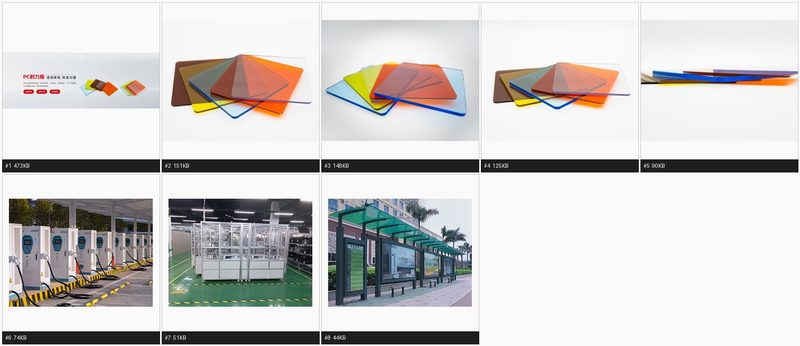
Specification
| Property | Specification |
|---|---|
| Material | 100% virgin polycarbonate |
| Thickness | 0.1 mm – 20 mm |
| Widths | 1220 / 1560 / 1820 / 2100 mm (other widths made to order) |
| Length | 2440 mm standard; cut to any length within transport limits |
| Colours | Clear, opal white, green, blue, grey, brown; custom to order |
| Light transmission | Up to 90% (clear) |
| Impact strength | Approx. 200× glass, 30× acrylic |
| Temperature range | −40 °C to 120 °C |
| Fire behaviour | B1, ignition point 580 °C, self-extinguishing |
| UV protection | Co-extruded one or both faces (specify for outdoor use) |
What solid sheet is good at
- It does not shatter. Under impact it yields and springs back. There are no fragments, which is why it passes where safety glass legislation applies.
- It survives cold. No embrittlement at −30 °C, verified stable to −40 °C. Acrylic in the same conditions cracks.
- It is quiet. 5–9 dB better sound reduction than glass of equal thickness — the reason it is standard on motorway noise barriers.
- It is light. About half the weight of glass, which changes the framing, the fixings and the installation cost, not just the panel price.
What it is not good at
Bare polycarbonate scratches. If the panel will be cleaned daily, wiped with abrasive cloths, or handled in a retail environment, specify the hard-coated grade instead — retrofitting a coating is not possible.
It is also attacked by some solvents and cleaning chemicals, notably ammonia-based glass cleaners. Tell us the cleaning regime and we will confirm compatibility before you commit.
Typical applications
- Machine guarding and equipment windows
- Carport, walkway and bus shelter roofing
- Security and anti-vandal glazing
- Motorway and railway noise barriers
- Signage faces and display fabrication
- Riot shields and protective screens
Minimum order and lead time
This grade ships from 100 m² or 1 tonne — a trial pallet, not a full container. Standard sizes and stock colours run in 7–10 days; non-standard thickness or width in 12–18 days; add 3–7 days for CNC cut-to-size work. Quoted in USD on FOB, CIF or DDP terms. Full detail on the MOQ, lead time & shipping page.
Questions buyers ask
What is the difference between solid and multiwall polycarbonate?
Solid sheet is a single dense layer — stronger, clearer and heavier. Multiwall has internal ribs and air channels — lighter, better insulating and cheaper per square metre, but not optically clear. Use solid where you look through it or hit it; multiwall where you roof with it.
Can solid polycarbonate be cold-bent on site?
Yes, within a minimum radius of roughly 150× the sheet thickness — so 3 mm sheet bends to about a 450 mm radius. Tighter curves need thermoforming, which we do in-house.
Do you supply sheet cut to size?
Yes, on 22 CNC machining centres at ±0.1 mm. Send DXF, DWG, STEP or PDF and we quote the finished part rather than the raw sheet.