Coloured Polycarbonate Sheet
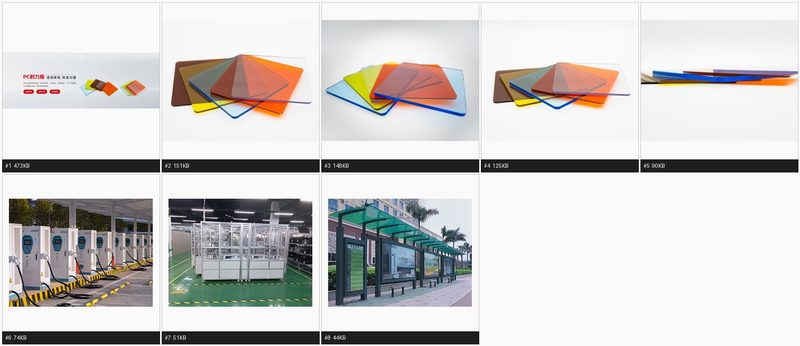
Tinted and solid colours extruded to your reference — green, blue, grey, brown, opal and custom.
Colour in polycarbonate is compounded into the melt, not painted or filmed onto the surface, so it goes right through the sheet. A cut edge shows the same colour as the face, and a scratch does not reveal clear material underneath.
We hold clear, opal white, green, blue, grey and brown as standard, and match custom colours from a Pantone reference, a RAL number or a physical sample.
Specification
| Property | Specification |
|---|---|
| Standard colours | Clear, opal white, green, blue, grey, brown |
| Custom colours | Matched to Pantone, RAL or a physical sample |
| Colour types | Transparent tint, translucent, solid opaque |
| Thickness | 0.1 mm – 20 mm |
| Widths | 1220 / 1560 / 1820 / 2100 mm (other widths made to order) |
| Lead time | Standard colours 7–10 days; custom colour matching 15–20 days |
| Light transmission | Varies by colour and depth — quoted per specification |
Typical applications
- Architectural glazing and privacy screens
- Signage and brand-coloured fixtures
- Bus shelters and street furniture
- Balustrade and canopy infill
- Interior partitions and decorative panels
Minimum order and lead time
This grade ships from 100 m² or 1 tonne — a trial pallet, not a full container. Standard sizes and stock colours run in 7–10 days; non-standard thickness or width in 12–18 days; add 3–7 days for CNC cut-to-size work. Quoted in USD on FOB, CIF or DDP terms. Full detail on the MOQ, lead time & shipping page.
Questions buyers ask
Can you match my existing panels exactly?
Send a physical sample rather than a colour code where possible. Codes describe the target; a sample shows how your current supplier actually hit it, including any drift.
Is there a surcharge for custom colours?
There is a colour-matching set-up cost and a longer lead time of 15–20 days, but the standard 100 m² / 1 tonne minimum still applies.
Does colour affect the fire rating or impact strength?
No. Pigments are added at low loadings and do not change the mechanical or fire behaviour of the base sheet.